
Understanding conversations better
for contact center intelligence

Designing the
from understanding customer intent to improving the models and journeys that respond to it.
[24]7.ai’s platform helped enterprise teams understand customer conversations, train AI models, build automated journeys and continuously improve their performance.
Conversational AI | Enterprise SaaS | Design system | Hospitality
9 application
ConvAI platform
95% accuracy
Intent recognition
85%
First call resolution

systems behind conversational AI
One conversation. Multiple systems behind it.
A simple customer conversation relied on a sophisticated ecosystem behind the scenes.
-
Intent Discovery revealed what customers were asking. Model Workbench trained and evaluated the AI interpreting those requests.
-
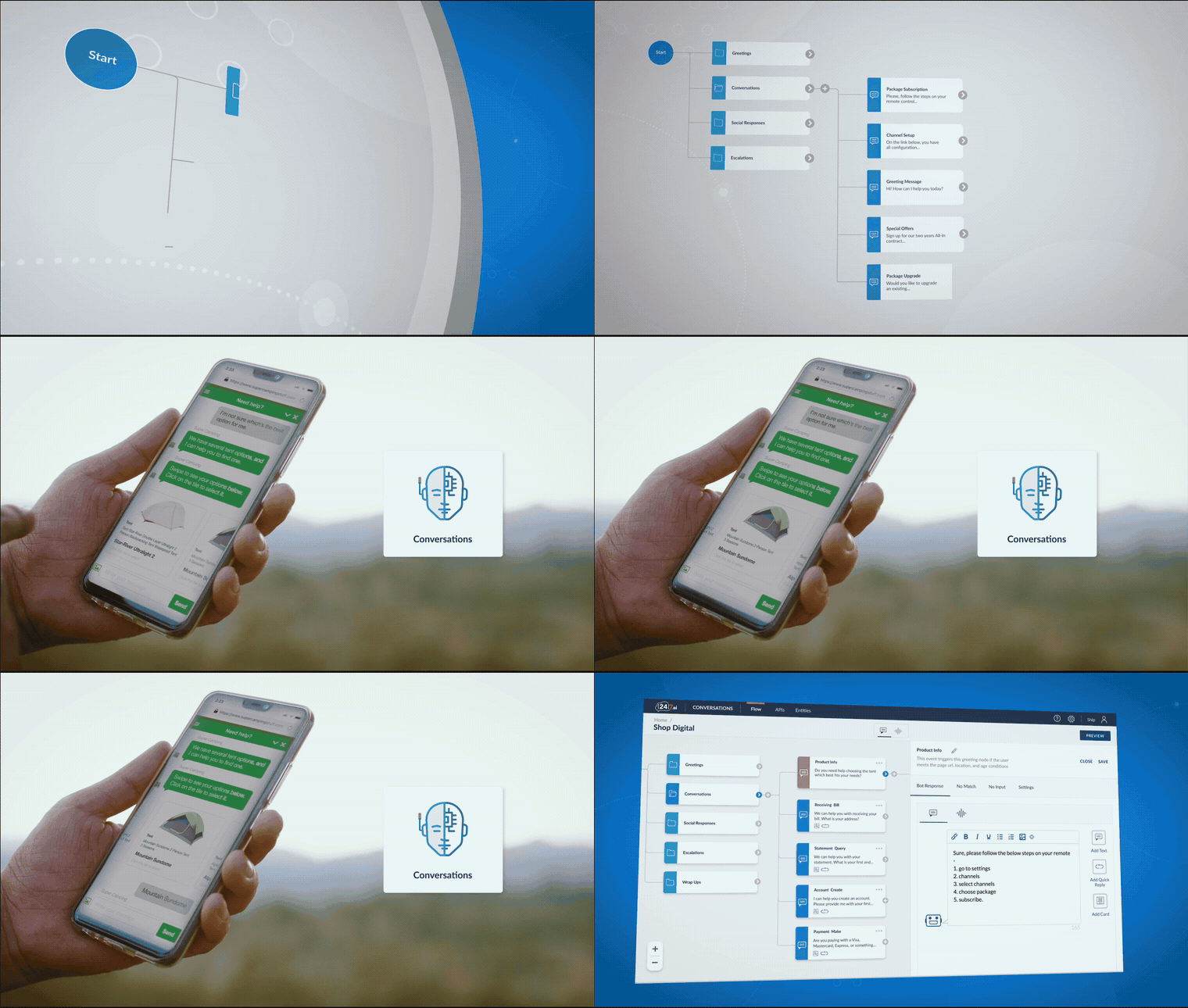
Conversation Builder turned that intelligence into journeys.
-
Envision showed how those journeys performed.
The opportunity was to make these specialised products work as one continuous improvement loop:
Listen → Understand → Improve → Deliver → Learn

A resolved conversation wasn't necessarily a successful one.
26%
Bot retention on second response
18%
NPS improvement
Containment told us whether customers stayed with the bot. It didn't necessarily tell us whether they had a good experience.
I combined behavioural data with qualitative research to understand where intent recognition, language and journeys were actually breaking down


Improving the intelligence behind the conversation
Emerging needs could be identified through Intent Discovery, models trained and tested through Model Workbench and the resulting intelligence translated into customer experiences through Conversation Builder.
Utterances→ Intent → Model → Conversation → Outcome
The design challenge was making sophisticated AI concepts self serve - understandable and actionable for enterprise users—not just data scientists.
95% accuracy
Intent recognition
85%
First call resolution


Working across the ecosystem exposed a larger problem: valuable intelligence existed across applications, but users still had to connect the signals themselves.
I led Optimiser, a product vision bringing those signals into a more actionable loop:
Detect issue → Understand why → Recommend action → Improve → Measure


Rather than another dashboard, the concept explored how the platform could help teams decide what to improve next. Ideas from the prototype subsequently influenced individual product backlogs and roadmaps.
Optimise - fragmented insights to action
